
GTP Load Balancer
GTP-LB is a GTP-C signalling proxy that sits between session-originating elements and a set of GGSN/PGW-side destinations, forwarding tunnel-management signalling — Create PDP Context on GTPv1, Create Session on GTPv2 — and every subsequent message in that tunnel's lifetime to the peer resolved for the subscriber, while rewriting the control-plane address so return traffic keeps flowing through it. That combination — topology hiding, per-subscriber peer selection, session-aware forwarding — is the established GTP Proxy role used at mobile network interconnect points.
Features & Benefits
GTPv1-C and GTPv2-C from one node
GTP-LB decodes and proxies both GTP protocol generations' control- plane signalling — Echo, Create PDP Context (v1) and Create Session (v2) — so a network running either generation, or both during a migration, is served by a single instance.
Subscriber-aware peer selection
Incoming session-establishment requests are matched against a rules table by IMSI or APN prefix, directing each subscriber's session to its configured destination rather than a single static peer for all traffic — the peer-selection half of the GTP Proxy role.
Session-aware forwarding for the life of the tunnel
Once a session is established, GTP-LB caches the TEID pairing and uses it to forward every subsequent message for that tunnel — Update, Delete and other in-session signalling — to the correct peer without re-evaluating the routing rules each time. This is the same session-state awareness a GTP Proxy relies on to produce accurate CDRs per tunnel.
Topology hiding,
transparent to both ends
GTP-LB rewrites the GSN address (v1) or F-TEID (v2) in signalling responses to point back at itself, so neither the originator nor the destination needs to be aware that traffic is being proxied, and the real GGSN/PGW behind GTP-LB is never exposed to the other side — the defining trait of a GTP Proxy deployed at an interconnect boundary.
GTP Load Balancing, GTP Proxy & GTP Firewall
"GTP load balancer" and "GTP proxy" are two distinct, well-established roles in mobile network engineering, alongside a third, adjacent security role, and the distinction affects what a product should be expected to do.
GTP-C Load and Overload Control
Since 3GPP Release 12, GTP-C carries its own load and overload signalling: a P-GW, S-GW or SAEGW can advertise Load Control Information and Overload Control Information directly inside GTP-C messages to its peers (MME, SGSN), so those peers steer new session establishment toward less-loaded destinations without any external load balancer sitting in the path (3GPP TS 29.274, Release 12 onward). This protocol-native load signalling, consumed by the peers themselves, is what a standards-compliant "GTP load balancer" actually distributes on, as distinct from a generic outbound round robin.
GTP Proxy
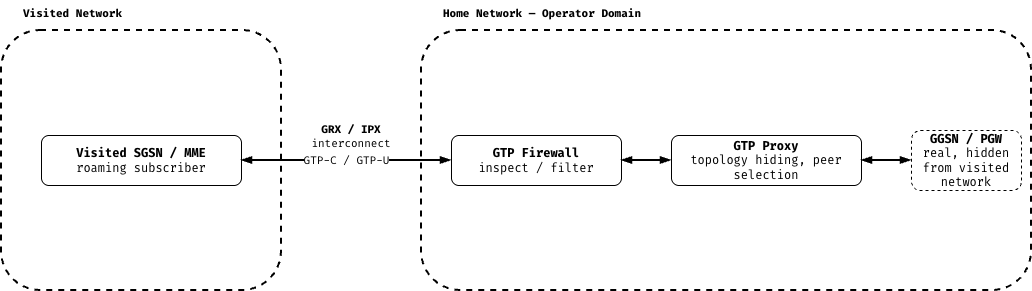
A GTP Proxy is the established role at the boundary between mobile networks, typically deployed at a GRX/IPX interconnect point: it terminates roaming GTP traffic arriving from a visited network and relays it to the real GGSN/PGW behind it. Its defining capabilities — topology hiding, session-aware CDR generation, peer selection based on reachability and load, APN manipulation in flight, and interworking between different vendors' equipment — describe almost exactly what GTP-LB's code already does in miniature, just not yet built out to the reliability or peer-selection depth the role implies at a real interconnect point.
GTP Firewall
A third, related category sits at the same GRX/IPX boundary for a different purpose entirely: inspecting and filtering GTP signalling and user-plane traffic against GTP-specific attacks — information disclosure, denial of service, fraud — since GTP was not designed with strong built-in security. This is a distinct product category, sold separately by vendors such as Palo Alto Networks, F5 and SecurityGen. GTP-LB's own configuration already has an unenforced firewall toggle — the shape of a GTP Firewall feature that was started and never finished.
Proxy GTP-C signalling to the right destination by subscriber
Session-aware forwarding for the life of the tunnel, entirely inside the operator domain
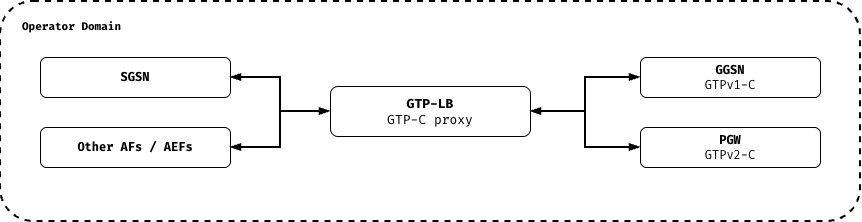
Deployed between GTP-C originators (SGSNs, other AFs/AEFs) and a set of GGSN/PGW destinations, GTP-LB inspects each session-establishment request, resolves the destination by IMSI or APN, and proxies the resulting tunnel's signalling for its lifetime. The whole path sits inside the operator domain — GTP-LB is a network-internal signalling proxy, not a northbound API exposure function, so no third party exposure mode applies.
Technical specifications
Northbound
None currently exposed
GTPv1-C
SGSN, GGSN
3GPP TS 29.060
GTPv2-C
SGW, PGW, MME
3GPP TS 29.274
Transport
UDP (port 2123)
Architecture
GTP-C signalling relay across GTPv1 (TS 29.060) and GTPv2 (TS 29.274) — no single dedicated architecture document
Ask us about our load balancers?
When and how to use a telecom protocol aware load balancer to optimize a workload.
Get in touch!